Since 2008, the MLN Group has held the concession for the Public Service for the Disposal and Recovery of construction and recovery waste not originating from minor construction or home repair work in the Autonomous Community of Aragon, Zone VI. It is currently the only public service for this type of waste operating in the Autonomous Community of Aragon, with disposal and recovery facilities at two different locations in the municipalities of Bárboles and Alfajarín in the province of Zaragoza.
It is therefore the only solution and the one that offers the most guarantees for the construction sector when dealing with construction and recovery waste from different types of projects.
S
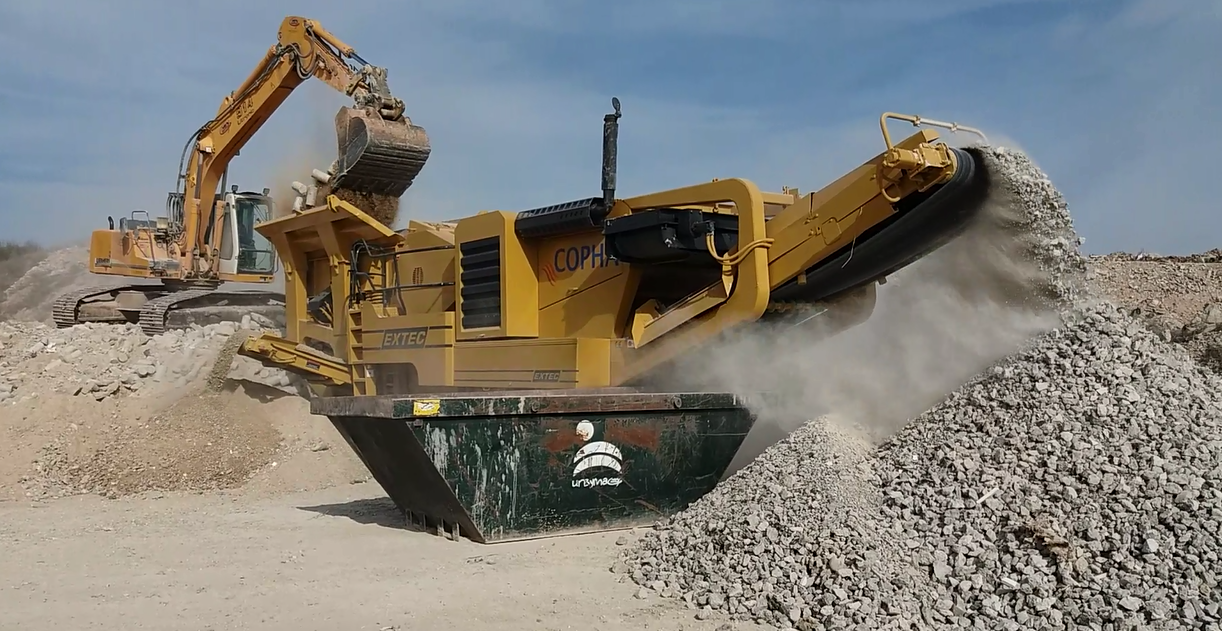
The recycling work carried out at the facilities aligns with the circular economy policy implemented for years by the MLN Group. The material received from various construction projects, both our own and those of others, is initially subjected to a material separation process to properly distinguish the different types of stone materials (concrete, bricks, tiles, asphalt mixtures, etc.) from the remaining materials. These latter materials, primarily plastics, paper, cardboard, and scrap metal, are delivered to authorized waste management facilities for further recycling and reintegration into the raw materials cycle.
The stone material is allocated, to the greatest extent possible, to be recycled and reused as soon as there is demand for it. This allows us to tailor the final product to the exact needs of the client, typically construction companies or local entities that require this type of material.
Furthermore, one of the Public Service’s waste disposal facilities is located in one of the Group’s operating quarries in the municipality of Bárboles. This activity also aligns with the Group’s circular economy philosophy, which is based on utilizing the natural resources it employs by applying them to specific activities and generating the least possible impact on waste production.
MLN owns more than 400 hectares of land for future aggregate extraction to support its main activity: civil engineering and the manufacture of concrete and asphalt.
While the land awaits development as a mining operation, the MLN Group’s Agricultural Division uses it for dryland cereal cultivation, giving it its first productive use. In fact, the harvest takes place during the first half of June.
When the necessary permits are obtained to operate the land as a quarry, natural aggregate is extracted, allowing for construction projects and the manufacture of asphalt and concrete, thus carrying out a second productive activity.
After years, once the aggregate has been extracted, a third step takes place:
the restoration of the quarry using surplus material from the excavation and soil from other sites. The restoration culminates with the planting of
new plant species, in this case olive trees and grapevines, from which
new products are extracted over time: oil and wine, produced by MLN’s Agricultural Division. In this case, one of the quarries is restored with the
construction of a waste disposal basin belonging to the public waste disposal service, ensuring full environmental safeguards in its
execution.
After this final step, the land is once again integrated into the landscape, generating no waste, having supported three productive activities, and with the capacity to continue generating wealth in the future.